



Eighty nine new millionaires a day. That is not a slogan or a marketing line. It is the literal pace at which the world is minting ultra wealthy people right now, according to Knight Frank’s newly released Wealth Report 2026, and it is the single most important number in real estate this year, even if most property headlines never mention it.
Here is what that number actually means, where it came from, and why it explains something that confuses a lot of regular homebuyers right now: how luxury property keeps climbing even when mainstream housing markets look shaky, sluggish, or stuck.
Where the 89 New Millionaires a Day Figure Comes From
Knight Frank’s Wealth Sizing Model tracks the global population of ultra high net worth individuals, people worth $30 million or more, known in the industry as UHNWIs. Between 2021 and 2026, that population grew from 551,435 to 713,626. Do the math across five years and you land on 162,191 new UHNWIs, or roughly 89 people crossing the $30 million threshold every single day, for five consecutive years straight.
That is not a short term spike. It is a sustained run, through a pandemic, a war in Ukraine, rising interest rates, and now a conflict in the Middle East. Liam Bailey, Knight Frank’s global head of research, called it evidence of “a deep structural acceleration in wealth creation worldwide.” Structural is the key word there. This isn’t a market correction waiting to happen. It’s a new baseline.
America Is Doing Most of the Heavy Lifting
Of every ten new ultra wealthy people created globally since 2021, four came from the United States alone. That 41 percent share has pushed America’s slice of the world’s total UHNWI population from 33 percent to 35 percent in just five years, and Knight Frank now forecasts it will hit 41 percent by 2031.
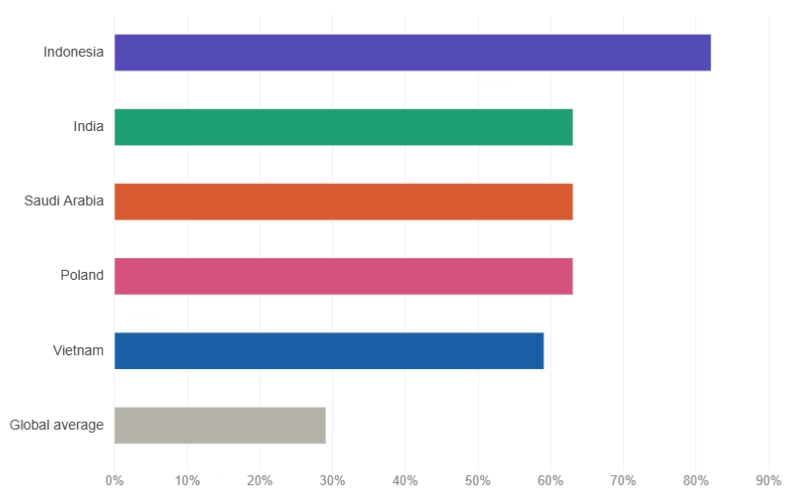
India tells a different but equally important story. Its UHNWI population jumped 63 percent over the same five years, the kind of growth rate that turns a country from a footnote into a genuine engine of global wealth. Indonesia, Saudi Arabia, Poland and Vietnam are all posting similarly explosive five year growth forecasts, proof that this wealth boom is no longer a story about one or two countries. It is becoming a genuinely global phenomenon, just with America still firmly in the driver’s seat.
The Luxury Shift: What Cartier’s Record Performance Tells Us About the Next Move in Real Estate
Why This Keeps Prime Property Climbing
Here’s the part that actually matters if you’re watching property prices and wondering why the top end of the market never seems to slow down. Knight Frank’s own research found that 22 percent of UHNWIs plan to invest in luxury residential property this year alone. With over 713,000 people in that wealth bracket worldwide, that single statistic represents an enormous, ongoing wall of capital looking for prime real estate to land in.
This is exactly why prime property keeps outperforming mainstream housing, even when ordinary buyers are dealing with high mortgage rates, tighter lending, and affordability pressure. The buyers driving prime markets in cities like Dubai, Miami, and Tokyo largely aren’t taking out mortgages at all. In prime central London, for instance, nearly half of all purchases happen without any borrowing whatsoever. When your buyer pool doesn’t depend on interest rates, broader housing wobbles barely register.
It also explains why scarcity at the top of the market behaves so differently from scarcity lower down. There simply are not enough move in ready, high quality homes to satisfy a population of new millionaires that grows by roughly 89 people every single day. Demand created at that pace outruns what developers can realistically build, particularly for turnkey homes wealthy buyers want without taking on renovation risk themselves.
What This Means If You’re Watching the Market
If you’ve been puzzled by headlines showing mainstream housing cooling in one breath and luxury prices surging in the next, this is your answer. Two different buyer pools are behaving in two completely different ways, and the wealth creation numbers explain exactly why.
For everyday buyers and sellers, the practical takeaway is this: don’t expect a slowdown at the top of the market to filter down and ease pressure on prime adjacent neighborhoods. The capital fueling luxury real estate right now isn’t reacting to the same economic signals as the rest of the housing market. It’s reacting to a wealth creation boom that, on Knight Frank’s own numbers, shows no sign of slowing before 2031.
For investors and developers, the opportunity is just as clear. A population adding roughly 89 new millionaires a day, with a fifth of them actively planning to buy residential property this year, is not a market anyone serious about real estate can afford to ignore. The question worth asking isn’t whether this wealth boom will keep shaping prime property. It’s which markets are positioned to capture the most of it.